Petty Powers™ · for girls 11 to 14
Turn what bugged her into a ridiculous supervillain.
She makes the villain. The room laughs. Then she decides what she does next.
A screen-free game for sleepovers, road trips, and family game night.
What is Petty Powers?
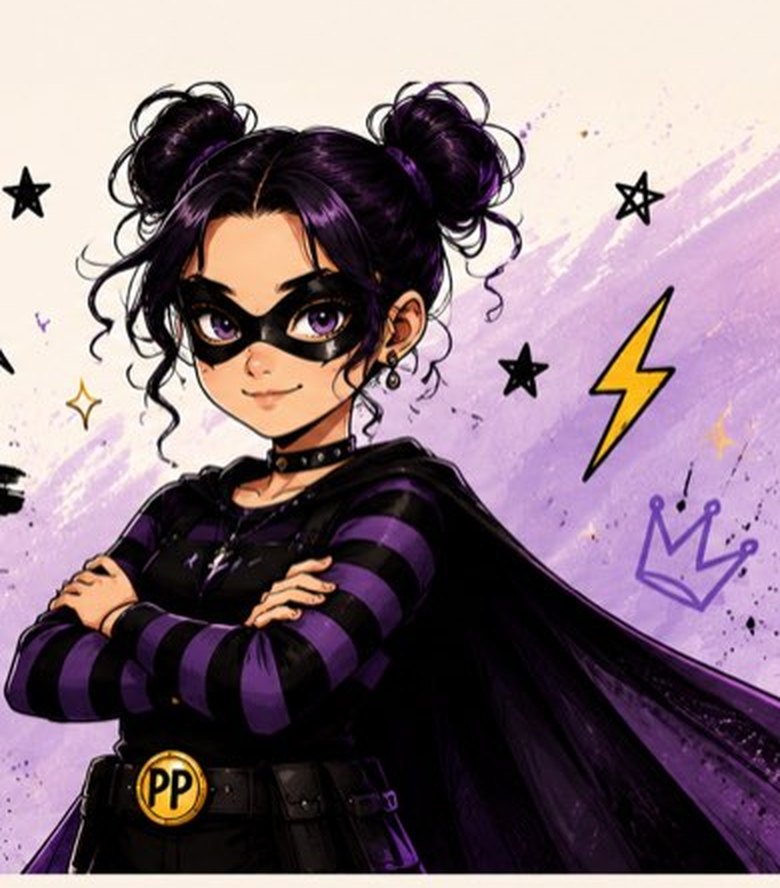
Petty Powers™ is a screen-free game from Faith Focus Haven™ for girls 11 to 14. Something small and annoying happens. She turns it into a ridiculous supervillain, then gives that villain a power that takes the problem way too far.
Then the group asks the real questions. Who else gets hurt? How does it backfire? And what could she have done instead?
It runs 2 ways. As a Would You Rather and activity game book, and as a live 90 minute workshop called the Villain Lab.
Why it works
The villains are silly on purpose
You cannot tell a girl this age that blaming people is immature. She will nod and stop listening.
But when she invents a supervillain whose whole identity is one small grudge, and the room laughs at how trivial it is, she gets there herself. The humor is not a warm-up for the lesson. It is how the lesson lands.
So the villains stay petty on purpose. Never cool, never scary. A villain she admires would break the whole thing.
The game
How does the game work?
3 steps, played out loud at the table. Fast, no writing, and nobody has to draw.
Step one
Problem
What actually happened? The small, real, everyday thing.
Step two
Villain
Who does it turn into? Give the blame a face and a name.
Step three
Power
What ridiculous power takes it way too far? This is where the room laughs.
Villain file
NO. 001Problem
A terrible school photo catches her at the exact worst second.
Villain
A ridiculous, photo-obsessed supervillain.
Power
Every camera waits until the worst possible moment to snap the picture.
The backfireWho else gets hit by this power, and how does it end up hurting the villain most of all?
The turnWhat could the villain have done instead, right back at the beginning? That is the opposite power.
What she leaves with
What she practices while she is laughing
She came in with something small that drives her crazy. She leaves with a way to handle it.
- Perspective
- Confidence
- Connection
- Creativity
- Laughter
She gets practice telling what happened apart from what she does next, which is the one piece of it she actually controls.
She thinks through consequences and who else they land on. She comes up with more than one way to respond instead of reacting from the first feeling. And she can name what bugged her without letting it run her whole day.
Where it gets played
When do you play it?
It needs no screen, no setup, and no pieces, so it travels.
Sleepovers
It works best loud, in a group, with everyone trying to out-ridiculous each other.
Road trips
Played out loud, so nobody needs a table, a pen, or a charged phone.
Family game night
The grown-ups are funnier at this than they expect to be.
Youth group and co-ops
Runs as a full session with a leader. That version is the Villain Lab.
The first Petty Powers book
It is a Would You Rather and activity game book, and it is in production now. It is not out yet. Join the list and you will hear when it is, along with the dates for the next Villain Lab.
Book news, free tools, and workshop dates. No spam, and you can leave any time.

Where it came from
It started at our kitchen table
Petty Powers™ was not invented in a meeting. Dee and her daughter Jolie made it up over lunch, turning whatever had annoyed them that day into ridiculous villains to make each other laugh.
Jolie came up with the core of it, including the fatal flaw rule. Every power has to come with a drawback. That rule is still what keeps the villains funny instead of cool.
The workshop
The Petty Powers Villain Lab
Ninety minutes, a leader, a room full of girls, and a finished creative piece at the end. Churches, co-ops, schools, camps, libraries, and girls groups can host one.
Before you ask
Questions parents ask
What ages is Petty Powers for?
Girls 11 to 14, middle school and early high. It also works at a mixed family table, because the grown-ups find it just as funny.
Does she have to be able to draw?
No. Nobody has to draw. The game is played out loud, and when girls make something they can pick a comic strip, a short script, a storyboard, a Would You Rather battle, or a filmed scene instead. Most girls do not draw, and it is built that way on purpose.
Is this therapy or counseling?
No. It is educational and creative, not clinical mental-health treatment. Serious trauma, abuse, danger, or personal disclosures are never used as joke scenarios.
Is it Christian?
Faith Focus Haven™ is a Christian company and faith is woven in gently, never preachy. There is no sermon in Petty Powers. Any girl can play it, and a Christian family will feel at home.
Is the book out yet?
Not yet. The first Petty Powers book is in production now, and the email list hears first.
Will it teach her to make fun of people?
The opposite, and the rules are built for it. The joke is always aimed at the invented villain, never at a girl in the room, and never at a real person. The game ends by asking who got hurt and what she could have done instead.
Why does this approach work?
Because the laugh does the teaching. A girl this age tunes out a lecture, but she cannot argue with a room laughing at a villain she invented herself, and that is when she sees how small the grudge was. The CDC also points to connectedness, a young person feeling accepted and cared for by the people around her, as something that protects well-being. Source: CDC on connectedness and youth well-being.
Petty Powers does not claim to treat anything, and it is not therapy. What it does is take the choice she still has, after something has already happened, and turn it into a creative exercise she can actually do in a room full of girls.